
Peaceful Planet began by delivering human rights workshops to Persian-speaking communities in London. That work led us to ask not only where human rights come from, but what enables people to put them into practice. The Universal Declaration of Human Rights begins with recognition of the inherent dignity of every person. To live with dignity, people need the knowledge, confidence and practical capacity to understand and influence the conditions in which they live.
One of the original, official Objectives of Peaceful Planet is:
To provide education that empowers, enhances and activates individuals and communities to implement their human rights.
The meaning of “to implement” is: to take steps to put into practice; to carry out or accomplish.
What has to happen before a person can implement their human rights in this sense? What inner and outer conditions need to be present? Thinking about the lives of people in Camden raised a practical question: how easy is it for people to exercise the rights and freedoms set out in the Universal Declaration?
This website addresses that question through practical tools for community empowerment, including a developing central London Community Project. Using those tools is implementing human rights.
Through conversations with residents in Camden, we have become increasingly aware of the difficulties people face when buildings and essential services deteriorate, and clear information is hard to obtain. Residents bring detailed knowledge of their surroundings. We are developing the London Community Project to help connect that knowledge with careful observation, scientific understanding and specialist expertise.
On the London Project page we we have created a Community Conditions Questionnaire so local people can describe and report on the conditions in which they live, identify matters of concern and contribute their knowledge and experience to improving their communities.
Through this questionnaire, local people can contribute knowledge and evidence that can be shared with engineers, scientists and responsible organisations, helping them work together to improve living conditions for young and old alike.
We are also developing tools to help residents communicate effectively with local and national representatives, so that those affected by decisions can reach those who make those decisions and have their voices heard.
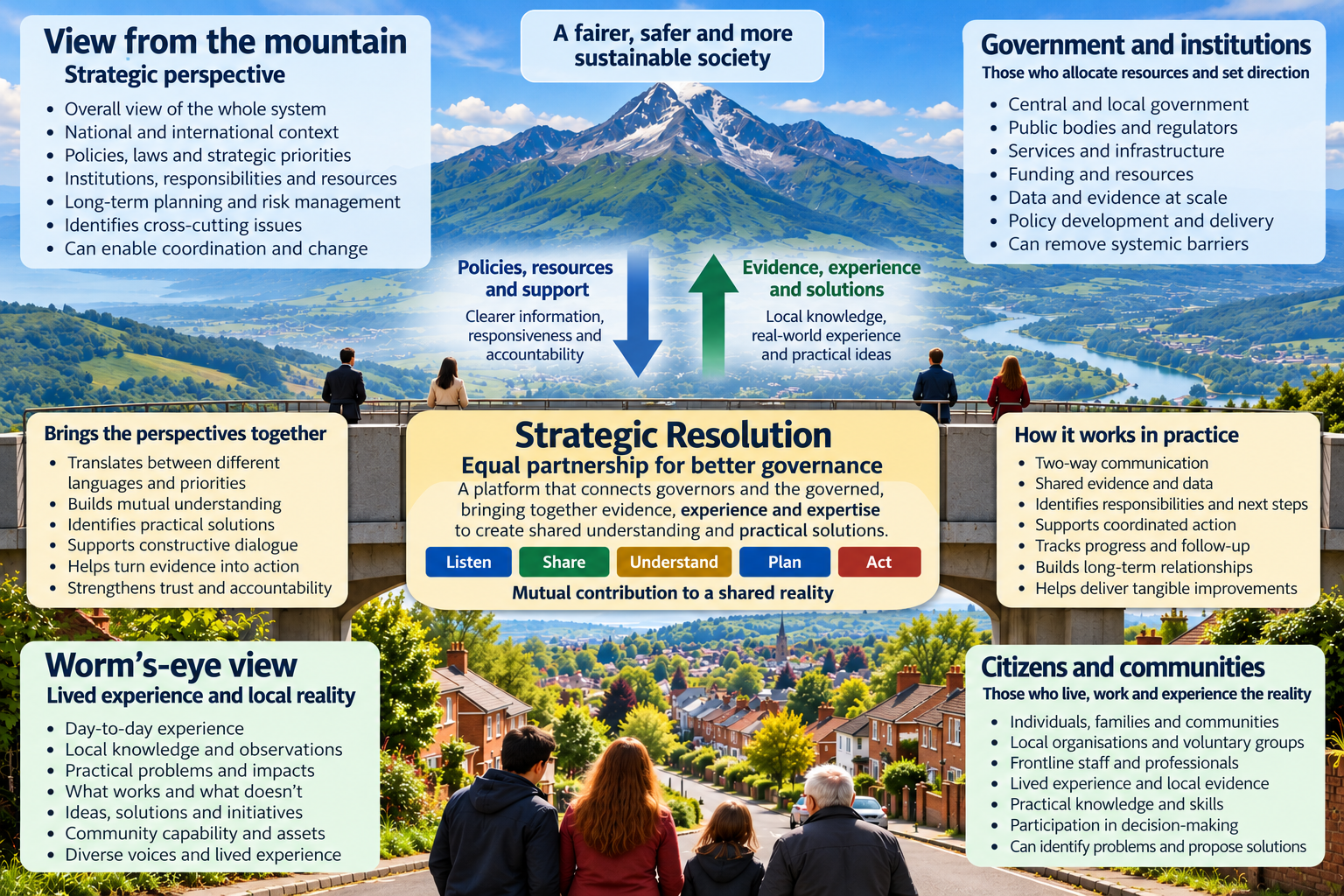
In this way, governance becomes a process whereby top down meets bottom up and a real, constructive dialogue can begin.
The diagram below shows how these different elements can connect.
In 2014 to 2015, the 800th Anniversary of the signing of the Magna Carta or Great Charter of civil liberties by King John of England, Peaceful Planet Human Rights Education delivered 170 workshops in London. Most of the workshops were delivered to Persian speakers but there were also workshops for Kurdish, Arabic and English speakers. The not for profit company was formed in 2017.
Why Persian? I was asked to speak at Birkbeck College about what my grandfather, Arnold McNair, had done in 1952 at the International Court of Justice in Holland. The Prime Minister of Iran/Persia had wanted to negotiate a share of the oil revenues for the Government and people of Iran with British Petroleum.
When this proved impossible he nationalised the assets of the British owned oil industry in his country. The British Government wanted to get them back and tabled a case at the International Court. It landed on my grandfather’s desk but the Court rejected the case, pointing out that it was a company that had had to surrender the assets and not a Government and the ICJ only hears cases submitted by countries, not companies. Then the CIA organised a coup and overthrew the democratically elected Government of the country.
I was also asked to talk about democracy as the Opposition in Iran was very fragmented and I took along a children’s human rights course that teaches the 30 rights of the Universal Declaration of Human Rights, or UDHR, which was signed by world leaders in 1948 after the horrors of the Second World War. The organisers in London asked me to come to another monthly meeting and speak about human rights but I suggested it would be better to start training instructors to run more workshops and that is what we did. Mahmoud Haidari, who had translated my talk for the group, delivered the first series of 15 workshops and from that group five of the original participants delivered at least one series of human rights workshops.
The Universal Declaration has an introduction, or Preamble. This is as important as the thirty rights. It tells how a tyrannical government leads to revolution and bloodshed and it answers the question, where do human rights come from – the need for respect for human dignity. I decided to research human dignity because I realised it is much more fundamental and universal than the 30 rights of the Universal Declaration. I found Dignity Its Essential Role in Conflict Resolution by Dr Donna Hicks, an Associate Professor at Harvard University (see below for link to bio) who has worked on conflict resolution issues around the world.
In her book, Dr Hicks describes a model for understanding and talking about human dignity. She has 10 Elements of Human Dignity, like acceptance of identity, acknowledgement, inclusion and fairness, contrasting that with 10 temptations to violate another person or group’s dignity. These are behaviours like being the victim, saving face and shirking responsibility. As I read her book I realised it is a powerful education in learning to be the best human being you can be and I created The Human Dignity Awareness Training Workbook from her elements and temptations.
Dr Hicks: https://www.hks.harvard.edu/about/donna-hicks
Our Story – Learn more
Discover how Peaceful Planet grew from human rights education into a wider exploration of dignity, capability and participation.
What We Do – Explore
Explore our programmes, projects and practical approaches for individuals, communities and institutions.
Courses and Languages – View Learning Resources
Human rights and dignity resources for children, young people and adults.